
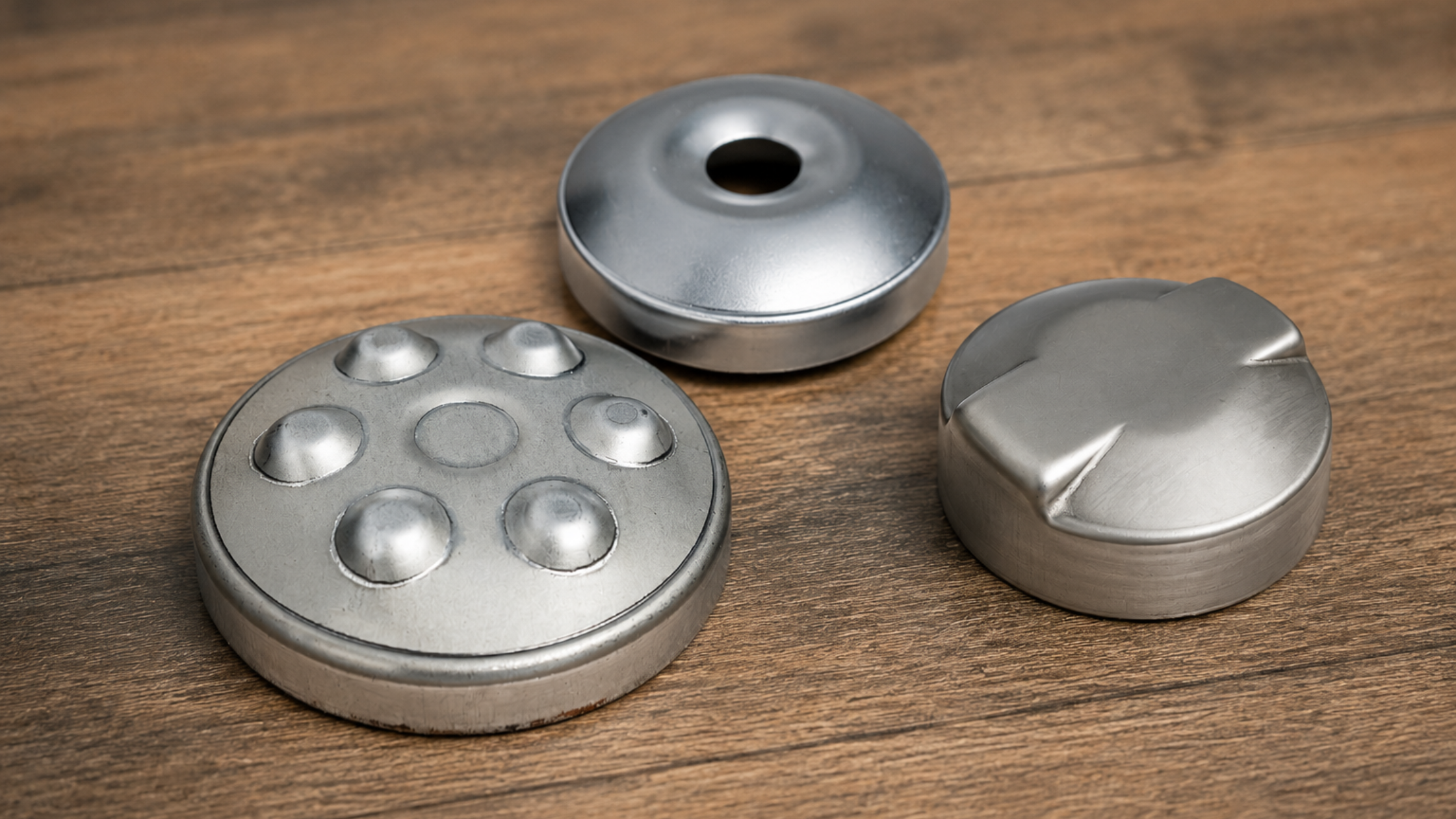
Refrigeration equipment runs for years without stopping. Compressors cycle on and off thousands of times, and metal parts expand and contract as temperatures swing from freezing to ambient and back again. Every stamped component inside that system has to hold its dimensions, resist corrosion, and keep working long after the warranty period ends.
That reliability starts on the shop floor, in the tooling and process controls behind every part. Refrigeration industry metal stamping is a discipline built around consistency, since a single out-of-tolerance bracket or housing can compromise a system’s seal, airflow, or electrical safety.
Common Metal Stamped Components in Refrigeration Equipment
Refrigeration systems rely on a wide range of stamped parts, each with its own tolerance and material requirements:
- Compressor housings and motor covers
- Mounting brackets and support structures
- Valve retainers and refrigerant system components
- Sensor and thermostat housings
- Electrical shielding and grounding components
- Deep drawn cups, sleeves, and cylindrical housings
- Clips, retainers, and fastening components
These parts operate under vibration, pressure fluctuations, and repeated thermal cycling. Many require tight dimensional control to support proper sealing, assembly, and system efficiency. For OEMs producing at high volume, part quality has to repeat across millions of cycles without drift.
Material Selection for Refrigeration Components
Material choice affects both how a part forms on the press and how it performs in the field for years afterward. Refrigeration components are exposed to condensate, humidity, and repeated temperature swings, so the material has to hold up mechanically and resist corrosion at the same time.
| Material | Corrosion Resistance | Formability | Common Use in Refrigeration |
| Stainless steel (300 series) | High | Good | Components exposed to moisture, condensate, or food-contact zones |
| Stainless steel (400 series) | Moderate | Good | Structural brackets and housings needing strength with some corrosion protection |
| Cold rolled steel | Low without coating | Excellent | Internal brackets, supports, and non-exposed structural parts |
| Galvanized steel | High | Good | Parts exposed to condensation or outdoor-adjacent conditions |
| HSLA steel | Moderate | Good | High-strength structural components with reduced weight |
| Aluminum | High | Good for 3000 series Moderate for 5000 series |
Lightweight housings, shielding, and deep drawn sleeves |
| Specialty coated steels | High | Depends on coating | Components requiring both formability and long-term corrosion protection |
Engineering teams weigh several factors when selecting a material for a refrigeration part:
- Corrosion resistance in moist, condensate-heavy environments
- Formability during deep drawing or progressive stamping
- Strength retention after forming
- Weldability, when the part requires secondary joining
- Surface finish requirements
- Compatibility with plating or secondary coatings
- How it dissipates or absorbs heat.
Manufacturing Challenges in Refrigeration Metal Stamping
Thermal cycling puts constant stress on formed metal. Parts expand and contract with every cooling and warming cycle, and the tooling strategy has to account for that movement to maintain dimensional stability across the product’s full service life. Minimizing distortion after forming is a core focus during tool design.
Corrosion protection matters because refrigeration components live in humid, condensation-prone environments for years. Material selection and surface treatment both play a role in extending service life, and the right combination is chosen based on where the part sits in the system and what it’s exposed to.
Long production programs are the norm in refrigeration manufacturing. Products can stay in production for a decade or more, which means tooling has to be built for extended life from the start. Preventive maintenance schedules keep dies producing consistent parts year after year, run after run.
Choosing the Right Stamping Process
Different refrigeration components call for different stamping approaches, whether that’s progressive die stamping for high-volume brackets or deep drawn stamping for cylindrical housings and sleeves. Curious about how these processes compare and which one fits your part? Read our blog comparing metal stamping processes for a closer look.
Engineering Considerations Before Tooling
Before a single die is cut, engineering work up front determines whether a program succeeds over its full production run.
Design for Manufacturability (DFM) evaluates whether the part geometry supports efficient stamping. This includes reviewing draw depth, radii, hole placement, and material thickness, and identifying ways to simplify tooling while keeping the part fully functional.
Tolerance analysis identifies which dimensions are critical to fit, function, or sealing, then builds a tooling strategy around those priorities. In-process controls are optimized to support long-term process capability, so the part stays in spec run after run.
Material behavior has to be accounted for early. Springback prediction, grain direction, formability limits, thickness variation, and yield strength differences between material lots all factor into a tooling plan that holds up over the life of the program.
Quality Control for Refrigeration Components
Consistent quality control keeps refrigeration parts performing to spec across long production runs. Common methods include:
- First Article Inspection (FAI)
- In-process dimensional inspection
- Statistical Process Control (SPC)
- Vision inspection
- Coordinate Measuring Machine (CMM) verification
- Tool wear monitoring
- PPAP documentation, where required
What OEMs Should Look for in a Refrigeration Metal Stamping Partner
An experienced stamping partner brings more to the table than press time. Look for:
- Engineering support early in product development
- Design for Manufacturability guidance
- In-house tooling capabilities
- Ability to support long production lifecycles
- Consistent process control
- Secondary operations and finishing capabilities
- Transparent communication throughout production
Conclusion
Refrigeration equipment depends on precision metal components that maintain performance throughout years of service. Successful programs begin with proper engineering, material selection, tooling strategy, and process control from day one.
Working with a metal stamping partner early in the design phase reduces manufacturing risk, improves part quality, and supports long-term production success.
Precision Stamping Company brings decades of experience engineering and producing stamped components for the refrigeration industry, with in-house tooling, robust process controls, and a track record of supporting OEM programs through years of production. If you’re developing a new refrigeration component or evaluating your current supplier, reach out to our team to discuss your project.