
Choosing a stamping process for a deep drawn part is a manufacturing decision with real cost and quality consequences.
Progressive die and transfer press are both proven methods for producing deep drawn components, and each brings distinct advantages depending on the part. An experienced precision metal stamping manufacturer evaluates the part itself before recommending a process, rather than defaulting to a single method for every program.
Every Part Starts with an Engineering Review
Process selection happens before tooling is designed, not after. Engineers evaluate manufacturability from the earliest stages of a program to determine which press architecture will produce the most consistent, cost-effective part over its full production life.
This review typically covers:
-
- Part geometry
-
- Material type and thickness
-
- Draw depth
-
- Required tolerances
-
- Production volume
-
- Secondary operations
- Long-term program economics
Selecting the right process upfront reduces manufacturing risk. A mismatch between part requirements and tooling architecture tends to surface later as scrap, inconsistent tolerances, or unplanned tooling revisions. Addressing the decision early keeps the program on track from the first article through full production.
How Progressive Die Stamping Works
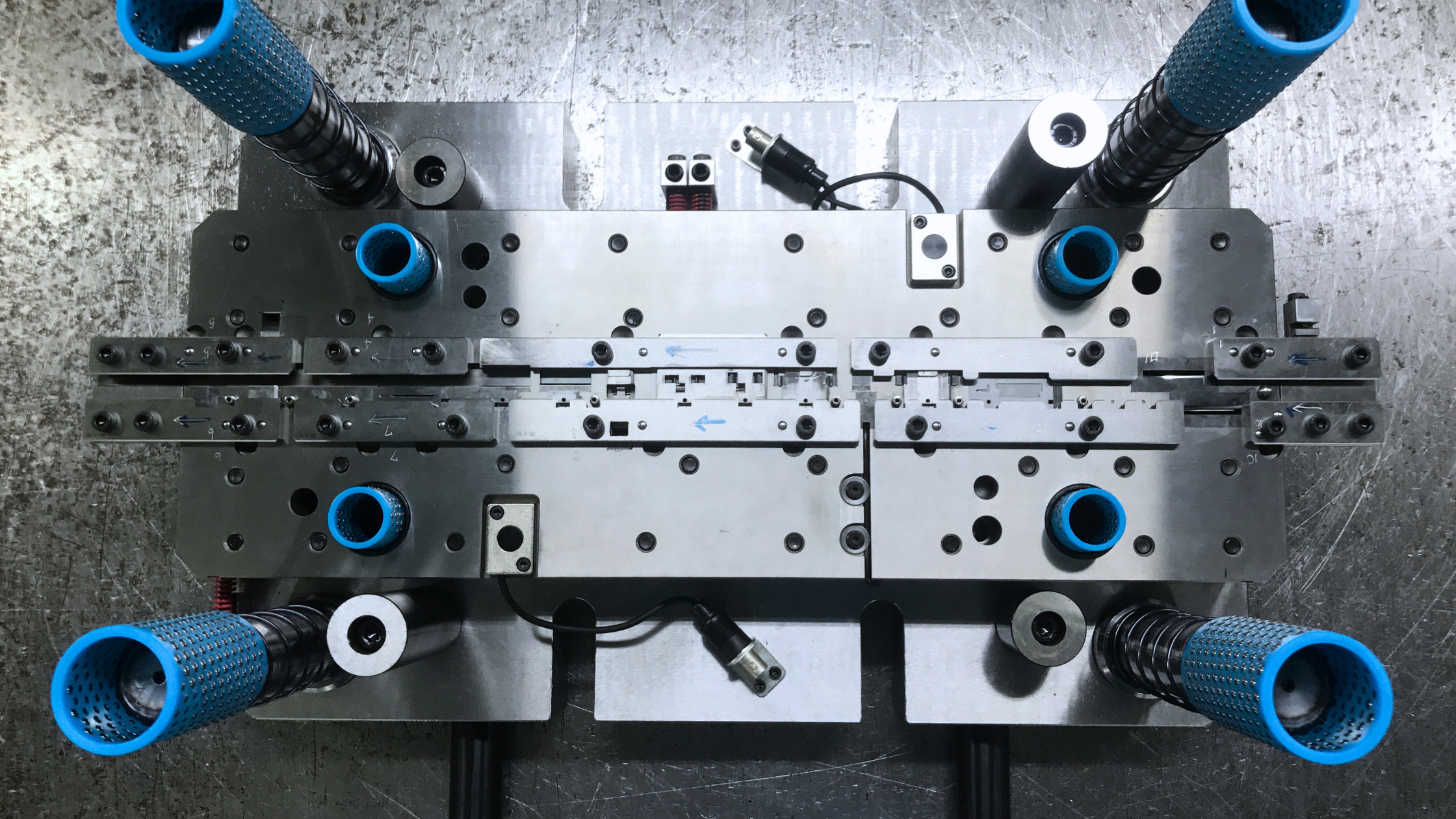
Progressive die stamping is a continuous strip-fed process. The material advances through multiple stations while remaining attached to the carrier strip, and multiple forming operations are completed within a single press cycle. Because the part stays connected to the strip until the final station, the process is well suited to parts that benefit from continuous, repeatable handling.
How Transfer Press Stamping Works
Transfer press stamping separates individual blanks from the strip. A mechanical transfer system then moves each part between stations, and forming operations are completed on individual parts rather than a continuous strip. This gives engineers more direct control over how the part is formed at each station, which matters for certain deep draw geometries.
Progressive Die vs. Transfer Press: What Actually Drives the Decision?
| Decision Factor | Progressive Die is Often Preferred When… | Transfer Press is Often Preferred When… |
| Part Geometry | The part can remain attached to a carrier strip throughout forming. Suitable for many shallow to moderately deep drawn parts and complex stamped geometries. | The part benefits from being separated from the strip early, allowing unrestricted access for deeper draws, especially of tubular components. |
| Material Flow | Material flow can be controlled while the part remains connected to the strip. | Independent part handling provides better control over material flow during redraw operations. |
| Tooling Architecture | The complete manufacturing sequence can be integrated into a single progressive die with continuous strip feeding. | Individual tooling stations and transferred blanks provide greater flexibility between operations and more economical tooling. |
| Material Utilization | Tooling is designed with material utilization optimized, including the carrier strip. Tooling repeatability and cycle times can outweigh the additional scrap. | Eliminating the carrier strip improves material utilization, especially for tubular, eyelet, or cup style components and higher cost materials. |
| Production Economics | Long-running, high-volume programs where continuous production and repeatability justify the tooling investment. | Programs where improved material utilization, forming flexibility, or part geometry provide a lower total cost over the life of the program. |
Why One Process Isn’t Better Than the Other
Progressive and transfer presses solve different manufacturing challenges. Neither process is universally faster or more capable. The best choice depends entirely on the part’s requirements, including its geometry, material, draw depth, and production volume. Engineering decisions should drive tooling strategy and not the other way around.
How a Precision Metal Stamping Manufacturer Makes the Recommendation
When evaluating a new RFQ, engineers assess a consistent set of criteria for every part:
-
- Part geometry
-
- Material selection
-
- Draw depth and forming sequence
-
- Required tolerances
-
- Annual production requirements
-
- Material utilization
-
- Tooling investment
- Long-term manufacturing stability
The objective is straightforward. Recommend the process that delivers the best combination of quality, repeatability, manufacturability, and total program value. That recommendation comes from data and part-specific analysis, not from a standing preference for one press architecture.
The Value of Early Engineering Collaboration
Reviewing prints before tooling begins gives engineers the chance to identify manufacturability concerns early, when changes are least expensive to make. Early collaboration allows part designs to be optimized for stamping, improves long-term process stability, and reduces unnecessary tooling and production costs.
Programs that involve engineering from the design stage tend to move through tooling development with fewer surprises. Draw depth issues, tolerance conflicts, and material flow problems are far easier to resolve on paper than after a die is cut.
Conclusion
Progressive die and transfer press stamping are both valuable manufacturing methods for deep drawn components. Choosing between them isn’t about selecting the better press. It’s about matching the tooling architecture to the specific requirements of the part, its material, its draw depth, and its production volume.
Working with an experienced precision metal stamping manufacturer like PRESCO ensures the process is selected based on engineering, manufacturability, and long-term production success rather than assumptions.
If your program involves deep drawn parts and you want a process recommendation grounded in engineering review rather than guesswork, reach out to discuss your part requirements. Our engineering team evaluates every RFQ against these same criteria to determine the tooling approach that will deliver the best quality, repeatability, and total program value for your specific application.