
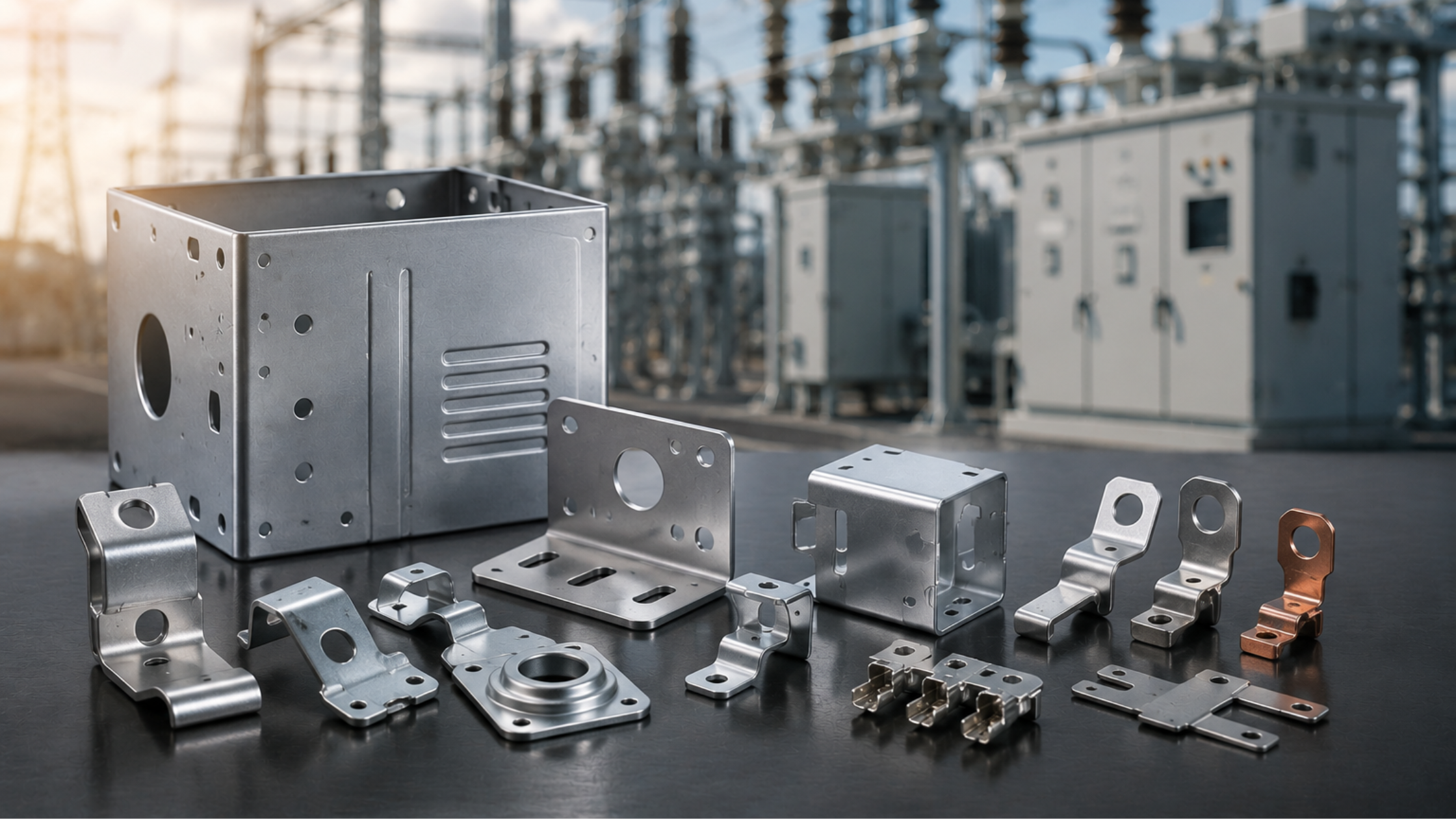
Power infrastructure depends on reliability. Whether supporting electrical distribution systems, backup power equipment, grid infrastructure, renewable energy applications, or industrial power systems, manufacturers in the power industry require components that perform consistently over long production runs and demanding service conditions.
For many of these applications, precision metal stamping provides an efficient and scalable way to manufacture high-volume components while maintaining the quality and repeatability critical to the industry.
The Role of Metal Stamping in Power Industry Manufacturing
The power industry relies on a wide range of stamped metal components that often go unnoticed but play an essential role in overall system performance.
Common applications include:
- Electrical enclosures and housings
- Connector, fittings and terminal components
- Sensor housings
- Shielding and grounding components
- Retainers, clips, and brackets
- Valve and fluid system components
- Battery and energy storage components
- Power distribution system hardware
- Fire protection and building system components
Many of these parts are produced in medium- to high-volume quantities, making metal stamping a practical manufacturing solution when repeatability, cost efficiency, and long-term supply stability are important.
Why Precision Matters
In power industry applications, small dimensional variations can create larger downstream problems.
Poor fit, inconsistent assembly performance, excessive wear, or unreliable electrical connections can all originate from component variation. Manufacturers need suppliers that understand not only how to produce parts, but also how those parts function within the larger system.
This is particularly important when parts must:
- Maintain tight dimensional requirements
- Fit consistently into automated assembly processes
- Support long production lifecycles
- Meet demanding quality expectations
- Deliver repeatable performance across millions of parts
Achieving these outcomes requires more than simply running a stamping press. It requires careful tooling design, disciplined process control, and a manufacturing partner focused on long-term program success.
Engineering Support Before Production Begins
Many manufacturing challenges are easier to solve before tooling is built.
That is why engineering collaboration early in the process can significantly improve manufacturability, reduce risk, and create more stable production programs.
At PRESCO, engineering review often begins with evaluating:
- Part geometry
- Material selection
- Functional tolerances
- Manufacturing feasibility
- Long-term production requirements
In some cases, small design adjustments can improve material utilization, simplify tooling, or increase process stability without affecting part performance.
The goal is not simply to quote a part. The goal is to help customers develop a manufacturing solution that performs reliably throughout the life of the program.
Selecting the Right Stamping Process
Different power industry components require different manufacturing approaches. Depending on part geometry and production requirements, we can use one of the below stamping processes for your component.
Progressive Die Stamping
Progressive die stamping moves a continuous strip of material through multiple stations within a single press. Each station performs a specific operation until the finished part is separated from the strip.
Common power industry applications include:
- Brackets and mounting hardware
- Electrical contacts and terminals
- Retainers and clips
- Shielding components
- Structural stampings
- Large electrical enclosures
Key advantages include high production speeds, excellent repeatability, reduced labor requirements, and cost efficiency for long-running, high-volume programs.
Progressive die stamping is often used for parts with relatively consistent wall thickness and geometries that can be formed while remaining attached to the carrier strip.
Deep Drawn Stamping
Deep drawn stamping transforms flat sheet metal into seamless three-dimensional components with relatively consistent wall thickness. It is commonly used when parts require strength, repeatability, and cost efficiency at production scale.
Common power industry applications include:
- Sensor housings
- Electrical enclosures
- Battery and energy storage component housings
- Protective covers
- Fluid system components
Key advantages include seamless construction, high strength-to-weight ratios, material efficiency, and excellent repeatability over long production runs. Deep drawn stamping is often selected when parts require a drawn geometry and high-volume production.
Depending on the part geometry and draw depth, deep drawn components may be manufactured using either progressive die tooling or transfer press tooling.
Transfer/ Eyelet Press Stamping
Transfer/ eyelet press stamping separates individual blanks from the material strip and transfers them between stations for forming operations.
Common power industry applications include:
- Complex formed housings
- Power distribution components
- Heavy-duty covers and shields
- Tubular or cylindrical components
- Components requiring deeper draw depths
Key advantages include greater forming flexibility, deeper draw capabilities, improved material utilization in certain designs, and the ability to manufacture more complex geometries.
Transfer/ eyelet press stamping is often selected when part geometry or draw depth exceeds the practical limits of a progressive die layout.
Selecting the Right Process Is Only the Beginning
Choosing between progressive die stamping, deep drawn stamping, and transfer press stamping is an important decision, but it’s only one piece of a successful manufacturing program.
The real challenge begins after the tooling is built and production starts. Parts must continue meeting requirements month after month, year after year, while maintaining quality, delivery performance, and cost expectations.
For power industry manufacturers, where products often have long service lives and extended production cycles, long-term manufacturing stability becomes just as important as selecting the right stamping process.
Quality and Consistency at Production Scale
In power industry applications, consistency is often just as important as precision.
A component that performs well during initial validation must continue performing the same way after hundreds of thousands or even millions of parts have been produced.
Achieving that level of consistency requires:
- Process control and monitoring
- Preventive tooling maintenance
- Material verification
- Capable inspection equipment and documented procedures
- Experienced personnel who understand the manufacturing process
Quality is not the result of a final inspection. It is built into every stage of production, from tooling maintenance and material management to ongoing process control on the shop floor.
Why Long-Term Manufacturing Partnerships Matter
Power industry programs are rarely short-term projects.
Many components remain in production for years, sometimes decades, making supplier stability just as important as part quality. Manufacturers need partners that can maintain tooling, support evolving requirements, and deliver consistent results throughout the life of a program.
That requires:
- Stable manufacturing processes
- Strong quality systems
- Transparent communication
- Reliable delivery performance
- A commitment to continuous process discipline
The most successful supplier relationships are built on trust, consistency, and accountability. When manufacturers can depend on their stamping supplier to deliver quality parts without creating administrative or production challenges, they can focus on serving their own customers with confidence.
Built for Long-Term Production Success
For 80+ years, PRESCO has helped manufacturers build stable, repeatable stamping programs that perform long after production begins.
From tooling and process development to ongoing production support, our focus is on delivering consistent quality, reliable delivery, and straightforward communication throughout the life of a program.
Customers choose PRESCO because they value:
- Over 80 years of metal stamping expertise
- Well-maintained tooling and disciplined manufacturing processes
- Transparent communication and honest feedback
- Consistent quality and delivery performance
- A single-source approach to tooling, stamping, and many secondary operations
The result is a manufacturing partnership focused on reducing risk, simplifying supply chain management, and helping customers keep production running smoothly.
Ready to Discuss Your Next Power Industry Project?
Whether you’re evaluating a new component, transferring an existing program, or looking for a more reliable stamping partner, PRESCO can help.
Our team will review your requirements, assess manufacturability, and recommend the stamping approach best suited to your application, volume, and long-term production goals.
Contact PRESCO today to discuss your project and speak with a member of our team.