
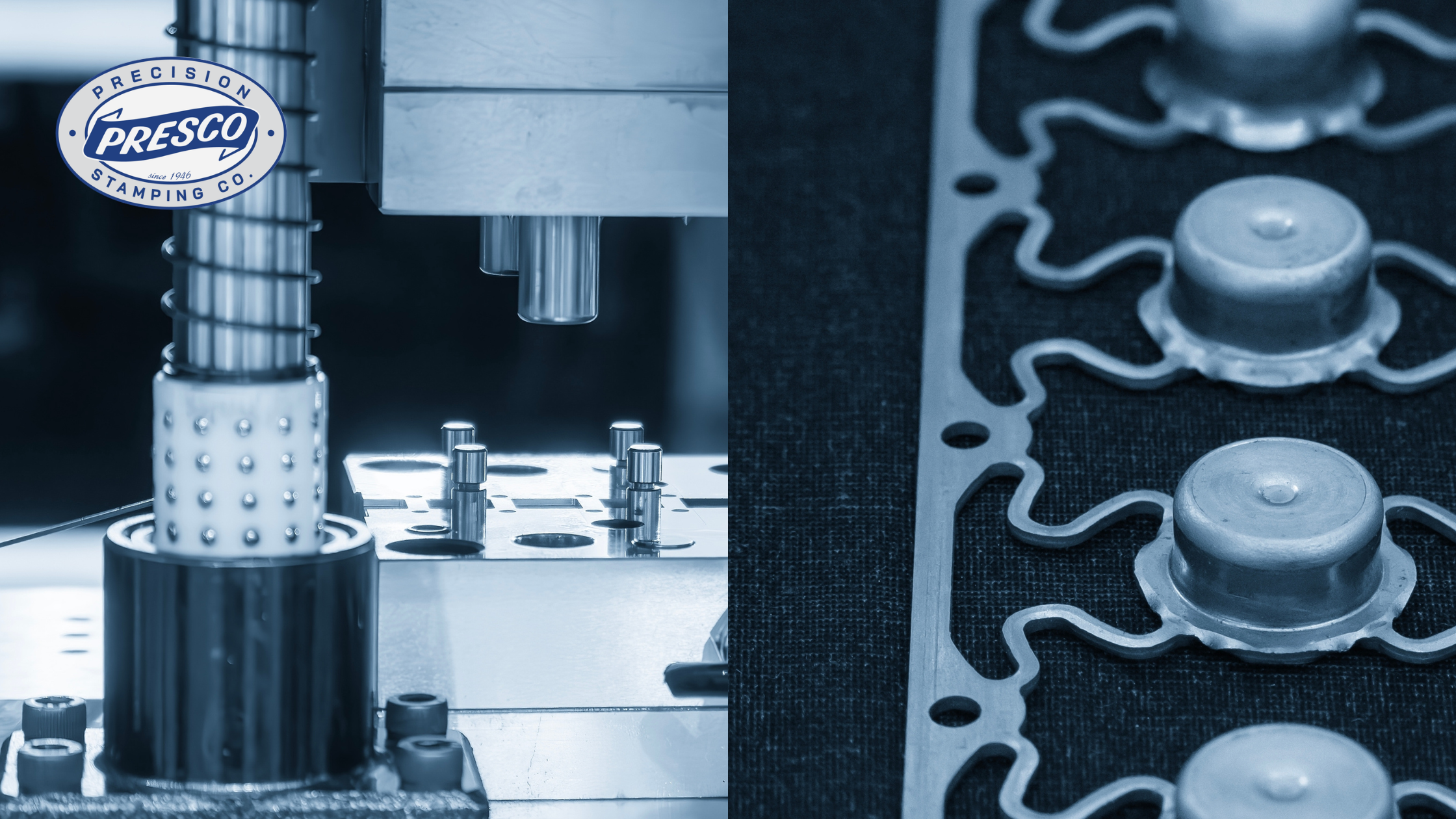
When it comes to precision metal stamping, two of the most common processes are progressive die stamping and transfer/eyelet press stamping. Both are capable of producing high-quality stampings, including deep drawn parts. However, they work differently and have different strengths. Choosing between them can have a real impact on the efficiency and cost of your program.
Here’s what engineers and procurement teams need to know.
How They Work
Progressive die stamping moves a strip of metal through a series of stations inside a single die shoe that is set up in a straight side press. The blank of the part to be formed is cut from the strip, but not completely separated from it. The blank remains attached to the strip with what is called a carrier – small pieces of the metal strip that connect the strip itself to the blank. The strip is progressed by one pitch for each stroke of the press and at each station a different operation is performed. Operations can include piercing, drawing, bending, rolling, beading, trimming, notching, and more. The die may contain as many progressions as there are operations to completely form the part. At the end of the process, a finished part is produced and the part is trimmed completely out of the strip.
Transfer press (eyelet) stamping takes a different approach. The part is separated from the strip early in the process, meaning the blank is cut completely free from the strip. The blank is transferred between individual die stations by mechanical fingers, grippers, or rails. Each station that the blank subsequently goes through is aligned and set independently at the press itself (vs. being contained in a single die/shoe). The blank, having been freed from the strip, will form slightly differently than if it were still attached within the strip via the carriers used in the progressive die.
Both processes can produce deep drawn components — parts formed via plastic deformation by forcing the metal blank into a die cavity to create cylindrical, box-shaped, or other three-dimensional forms. The choice between stamping methods depends on part geometry, material efficiency, and program volume.
Where Progressive Die May Be the Better Fit
Progressive die tooling remains in the assembled state between runs (except for servicing the tool details) and can include a wide variety of tool operations – as long as it can be engineered to work within the die shoe itself. Progressive dies are able to accommodate a wide range of part types, from deep drawn components to simple & complex brackets, washers, and covers/plates. Because the tooling stays in an assembled state, setup generally involves installing the die shoe into the press, squaring it up to the ram, setting the shut height of the press for that specific tool, and setting the feed per the pitch of the die.
It is generally a quicker setup than that of transfer press tooling. It is also potentially more flexible in that it can run in a wider variety of straight side press sizes as long as the bed, tonnage, and shut height of the press can accommodate the die.
Progressive die is often the right choice when:
- The parts are not round or cylindrical (easier to move between operations while contained in a strip)
- Bracketry or flatwork is involved alongside drawn/3D geometry
- Part complexity, size or material thickness makes transfer tooling impractical
- There is a tonnage limitation – most transfer/eyelet presses have a lower tonnage capacity
- Program volumes require multiple tool cavities within the same die or quick change-overs (setups)
Examples of progressive die style parts would be the hinges on your refrigerator door or the wire harness under the seat of your car.
Where Transfer Press May Be the Better Fit
Transfer/eyelet presses are a more specialized type of press (& tooling) that are particularly well-suited for cylindrical deep drawn components where material utilization matters. Because the part leaves the strip early, excess material isn’t required for stretch webs (carriers) to carry the part through the entire die sequence.
This can make a meaningful difference in scrap rates and cost per part. Transfer press tooling is generally set up 1 operation at a time via a setup process that is more time-consuming compared to the setting of a progressive die in a straight side press. Each station’s timing and fine adjustment can be highly customized without significant tooling adjustments – because the press is adjusted, not the tool details/dies themselves. The process can be defined as its own highly specialized trade.
Transfer tooling also excels when:
- The parts are round or cylindrical and can be easily transferred between operations
- Material efficiency is a priority, especially for high-cost or specialty materials
- The customer is seeking a lower initial tooling investment (especially for lower-medium volume programs)
Examples of transfer/eyelet style parts would be ferrules, grommets, round steel motor housings, and hose/tube ends.
Progressive Die vs. Transfer Press
|
Factor |
Progressive Die Stamping |
Transfer Press/Eyelet Stamping |
|
Part Types |
Deep drawn, brackets, flatwork, washers, covers — broad range |
Primarily deep drawn, round components |
|
Material & transfer mechanism |
Strip carrier supports and transfers parts through the process |
Part transfer doesn’t require carriers, resulting in less scrap required. |
|
Versatility |
High, progressive dies can be built to handle a wide array of geometry requirements |
Specialized for drawn and deep drawn components |
|
Setup Complexity |
Generally, a simpler and more standard setup process = faster setup |
Requires skilled setup tradespeople to align and adjust each station |
|
Tooling |
Remains assembled in a die shoe throughout production and in storage |
Tool details are kept in an individual state to be assembled at/in the press |
|
Best For |
Non-cylindrical part geometries, parts requiring more operations than a transfer press has stations for, parts requiring intricate features that are non-symmetrical |
All volumes of drawn and deep drawn parts, lower initial tooling costs, and material cost optimization. |
The Decision in Practice
The decision between progressive and transfer isn’t always a hard line – many deep drawn parts can be run in either process. Whenever Presco evaluates a RFQ opportunity, we are already evaluating what type of tool and press would be optimized for the specific geometry required.
The transfer/eyelet tool process will not apply to as many different geometries as a progressive die process could, but it is a very efficient process for a specific spectrum of part geometries. A progressive die, meanwhile, can be a very efficient (low cycle time) process for round, non-round, flat, and bracket style parts that require a wide range of formed features. Both processes can offer high precision and greatly reduced economics when compared to line die, machined/turned parts, or parts made via other slower cycle time processes.
When a manufacturer evaluates your part, they’ll consider overall complexity, required depth of draw, the number of operations needed, material type, material thickness, and annual volume. Then they will match those factors to the process best suited to deliver consistent quality at the lowest sustainable cost.
Working with a Stamping Partner
The right process isn’t just about the part in isolation but about the full program.
A capable stamping partner will analyze the part design upfront, ask the right questions about tolerances and finishing requirements, and invest in a process path that’s built for long-term stability.
Whether your application calls for progressive die stamping, transfer press stamping, or you are not sure, the goal is the same: predictable quality, efficient production, and a manufacturing program that holds up run after run.
Have a part you’d like to discuss? Contact our team to start a conversation about your stamping requirements.