
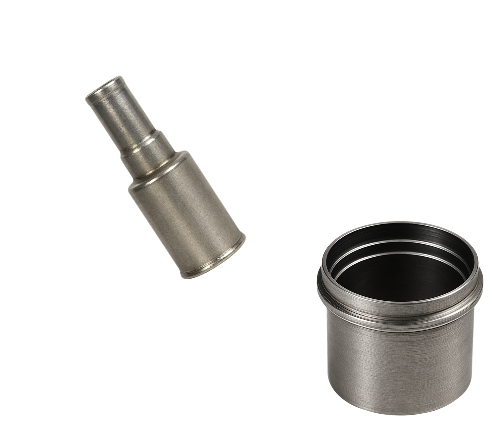
Transfer press stamping and progressive die stamping are both capable of producing high-quality, deep drawn and formed parts. The difference lies in how the material moves through the process and how that movement influences geometry, scrap rates, and tooling strategy.
Transfer press stamping separates the part from the strip early and moves it independently through each forming stage. Progressive die stamping keeps the part attached to the strip via carriers as it progresses through a series of stations within a single die. That distinction shapes how each process performs under different design and production conditions.
Understanding where each method fits allows engineering and sourcing teams to align part design with the most efficient manufacturing path, before tooling decisions are locked in.
How Transfer Press Stamping Works
Instead of keeping the part attached to a continuous strip of metal, transfer press stamping separates individual blanks from the strip early and moves them between stations independently.
This allows for better material utilization, since there is no carrier strip consuming raw material throughout the process. That distinction matters most for axisymmetric, deep drawn, or cylindrical parts where draw depth and geometry are the primary drivers of process selection.
After the blank is cut free, the rest of the transfer press stamping process continues:
Step 1: The blank is moved between stations using mechanical fingers, rails, or grippers
Step 2: Each station performs a specific forming operation
Step 3: Stations are independently aligned and adjusted at the press
Why This Matters in Design and Sourcing
From a design-for-manufacturing perspective, the biggest implication is material properties. This often translates directly into improvements in piece price and yield, particularly when working with higher-cost materials such as stainless steel or specialty alloys.
When a part remains attached to a strip:
-
- Material flow may be constrained
-
- Additional material is required for carriers
- Scrap rates can increase
When a part is transferred freely:
-
- Material flows more evenly into the die
-
- Less excess material is required
-
- Scrap can be reduced
When Transfer Press Stamping Is the Better Fit For Your Project
Transfer press stamping excels in a specific range of applications, and is typically the right choice when:
1. The Part Is Cylindrical or Deep Drawn
Generally, axisymmetric geometrical parts such as housings, ferrules, and enclosures are well suited for this process, provided draw depth and material thickness fall within the practical limits of a continuous strip press. Parts that are too tall or too thick for the eyelet press would move to a progressive die instead.
2. Material Efficiency Is a Priority
Because the process eliminates the need for carriers, it reduces scrap.
This becomes especially valuable when:
-
- Material costs are high
-
- Volumes are moderate to high
-
- Sustainability goals are part of sourcing decisions
3. Lower Initial Tooling Investment Is Needed
Transfer tooling can sometimes require a lower upfront investment, particularly for lower to medium production volumes.
4. Process Flexibility at the Press Is Required
Each station can be adjusted independently, allowing for fine-tuning without major tooling redesign.
When Progressive Die Stamping Is the Better Fit For Your Project
Eyelet transfer press stamping has two hard limits: material thickness and draw depth. If the material is too thick or the overall height of the part is too tall, the process simply isn’t viable, and the part moves to a progressive die instead.
Because the tooling remains assembled in a single die shoe, setup is faster and more standardized. It is also the only practical option when material thickness or draw depth exceeds what an eyelet transfer press can accommodate. It is often preferred when:
-
- Parts are non-cylindrical, asymmetrical, or involve irregular shapes, such as brackets and flat components
-
- Faster setup and changeover are desired
-
- Higher tonnage applications exceed transfer press limits
-
- Extremely high volume is required — progressive dies can be configured to produce multiple parts per press stroke (for example, a three-out die running at 40 strokes per minute produces 120 parts per minute), which transfer presses cannot match
Key Differences: Transfer Press vs. Progressive Die
| Transfer Press Stamping | Progressive Die Stamping | |
| Part Type | Deep drawn, cylindrical | Wide range – flat, formed, complex |
| Material Handling | Free part transfer | Strip with carriers |
| Material Efficiency | Higher – less scrap | Lower – carrier material required |
| Setup | More complex, station-by-station | Faster, standardized |
| Tooling | Modular, adjusted at press | Fully assembled die |
| Versatility | Specialized | Highly versatile |
Making the Best Decision
Many parts can technically run in either process. A manufacturer evaluating your part will consider:
-
- Part Geometry
-
- Depth of draw
-
- Material type and thickness
-
- Number of forming operations
-
- Annual volume
- Cost targets
From there, they determine which process delivers the best balance of:
-
- Quality consistency
-
- Material utilization
- Long-term production stability
What This Means for Your Team
If you are in advanced purchasing, sourcing, or product engineering, the key shift is to select the process early, not after the RFQ.
These questions reduce iteration cycles and improve long-term program outcomes:
-
- Can this geometry run more efficiently in transfer?
-
- Is material utilization optimized?
- Are we designing for the right process from the start?
Working with the Right Stamping Partner
Because the goal is to build a stable, repeatable manufacturing program, a capable stamping partner will:
-
- Evaluate your part geometry before tooling decisions are finalized
-
- Identify opportunities to reduce scrap and improve yield
-
- Align process selection with long-term production goals
-
- Balance tooling investment with lifecycle cost
Selecting the Right Process
Transfer press stamping is a powerful solution, but only when applied to the right geometry and production scenario.
The difference comes down to one core principle: selecting the process that aligns with your part geometry, production volume, and long-term manufacturing strategy.
Working with a stamping partner that evaluates these factors early can help reduce risk, improve material utilization, and support consistent production outcomes over time, an approach that companies like Precision Stamping continue to prioritize across projects.
An early conversation can help clarify the best path forward before tooling decisions are locked in: Talk With An Engineer