
Deep Drawn Stamping


Why choose deep drawn stamping?
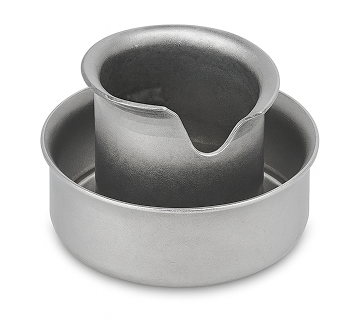
If your requirements include a 3-dimensional shape with a consistent wall thickness, draw or deep draw stamping may be the right forming method for you.
A deep drawn part can be produced using progressive dies, transfer presses, and other stamping configurations. Deep drawn stamping is a strong fit when a part requires drawn shapes, such as:
- Cups, shells, housings, enclosures
- Cylindrical or box-like geometries
- Controlled material flow rather than material removal
- Smooth surfaces and consistent wall thickness
- Repeatability at volume
Our Tooling Strategies
Deep drawn stamping is not a one-size-fits-all process. At PRESCO, we apply multiple tooling strategies based on part geometry, material behavior, and production requirements to ensure the most reliable and cost-effective outcome.
THROUGH PROGRESSIVE DIE
- High-speed production
- Thicker materials
- More complex geometries
- Repeatability and tight tolerances
Through transfer & eyelet press
- Deeper draws
- Smaller, precision components
-
Specialized presses engineered
specifically for deep draw components - Repeatability and tight tolerances
In transfer or eyelet press stamping, individual blanks are separated early from the strip between stations, allowing each forming step to be optimized independently. Because the part is free during the process, this method provides better material utilisation. Learn More
The Benefits of Deep Drawn Stamping
Deep drawn stamping is ideal when you need to make a high-volume of parts with complex geometries. It’s a versatile process that allows the metal to maintain its integrity and quality surface finish.
Other benefits or choosing deep drawn stamping include:
High-speed production
Deep drawn stamping machines operate with speed and precision, making this an ideal process for making a lot of components quickly
Outstanding durability
When metal is formed using the deep drawn process, it maintains its strength, which makes deep drawn stamping ideal for parts needed for extreme, harsh conditions. It also produces seamless parts for waterproof and airtight needs
Custom parts
Since deep drawn stamping can manufacture complex parts, there are endless possibilities for custom parts
Less waste
Deep drawn stamping greatly reduces scrap material because the starting amount of material is customised for the specific tool and part. Material efficiencies save money and are friendly to the environment
INDUSTRY APPLICATIONS
Deep drawn stamping is used across different industries. Here are some practical ways we see deep drawn stamping improve our world every day.
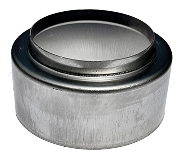
Exhaust
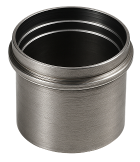
Pumps
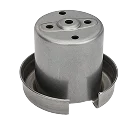
Power Tools
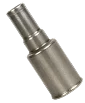
Air / FLuid Transfer
Electrical
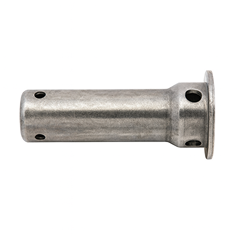
Flow Restrictor
Is deep drawn stamping right for you?
This chart shows how deep drawn stamping compares to other popular metal forming methods, such as CNC machining and metal spinning.
It takes into account some of the top considerations like cost, efficiency, thickness control, surface finish, and more.
Click to compare (or close)
| Criteria | Deep Drawn Stamping | CNC Machining / Turning | Metal Spinning |
|---|---|---|---|
| Best For | Hollow, formed parts with smooth walls, radius transitions, and repeatable geometry | Complex geometries requiring sharp transitions, low volumes, and variable wall thickness | Axisymmetric parts with consistent wall thickness (cylindrical, conical, or rounded shapes) |
| Typical Part Types | Cups, shells, housings, enclosures | Blocks, precision components, and thicker parts | Cones, domes, cylinders, and pressure vessels |
| Piece-Part Cost at Volume | Low | High | Moderate |
| Material Efficiency | Very high (minimal waste) | Low (significant material removal) | High (minimal waste, similar to stamping) |
| Wall Thickness Control | Excellent (thin, consistent walls) | Good but inefficient | Good (may experience thinning depending on geometry and process) |
| Surface Finish | Smooth, uniform | Very good | Good (can require secondary finishing depending on requirements) |
| Dimensional Repeatability | High | High | Moderate to high (more operator/process dependent than stamping) |
| Lead Time (Production) | Fast once tooled | Slower | Moderate (lower tooling investment, faster setup than stamping) |
| Common Replacement Scenario | Replaces machined or cast hollow parts to reduce cost | Used for prototypes or low-volume production | Used instead of deep draw or fabrication for round parts at lower volumes or when tooling investment needs to be minimized |
Experience the PRESCO Advantage
- 80+ years of stamping focus
-
Complex geometries and
tolerances down to +/- 0.001” - Deep process and tooling expertise

Quality & Process Control Built for Metal Stamping
PRESCO approaches deep drawn stamping as an engineered solution. We evaluate geometry, materials, volume, and lifecycle to determine the most reliable and cost-effective way to form your part, not just the fastest way to run it. At PRESCO, quality is engineered into every stage of production.

Advanced Inspection
Every deep drawn stamping project is supported by inspection methods selected specifically for the part’s geometry, tolerance requirements, and functional use, not generic spot checks.
Quality capabilities
Our approach to quality ensures that parts produced at high speed maintain dimensional integrity, functional performance, and consistency over long production runs.
Programmable Mitutoyo CMM
for dimensional verification and repeatability
Optical comparators
for profile and feature inspection
Surface metrology
to verify critical finishes and contact surfaces
Leak and burst testing
for functional validation where performance matters
Custom attribute gauges and fixtures
developed for every part, ensuring consistent inspection at production speeds
Reach out to talk to our team about deep drawn stamping.
We’d love to hear your questions and collaborate with you on your ideas. Fill out a form to talk to an engineer or get a quote for your part.