
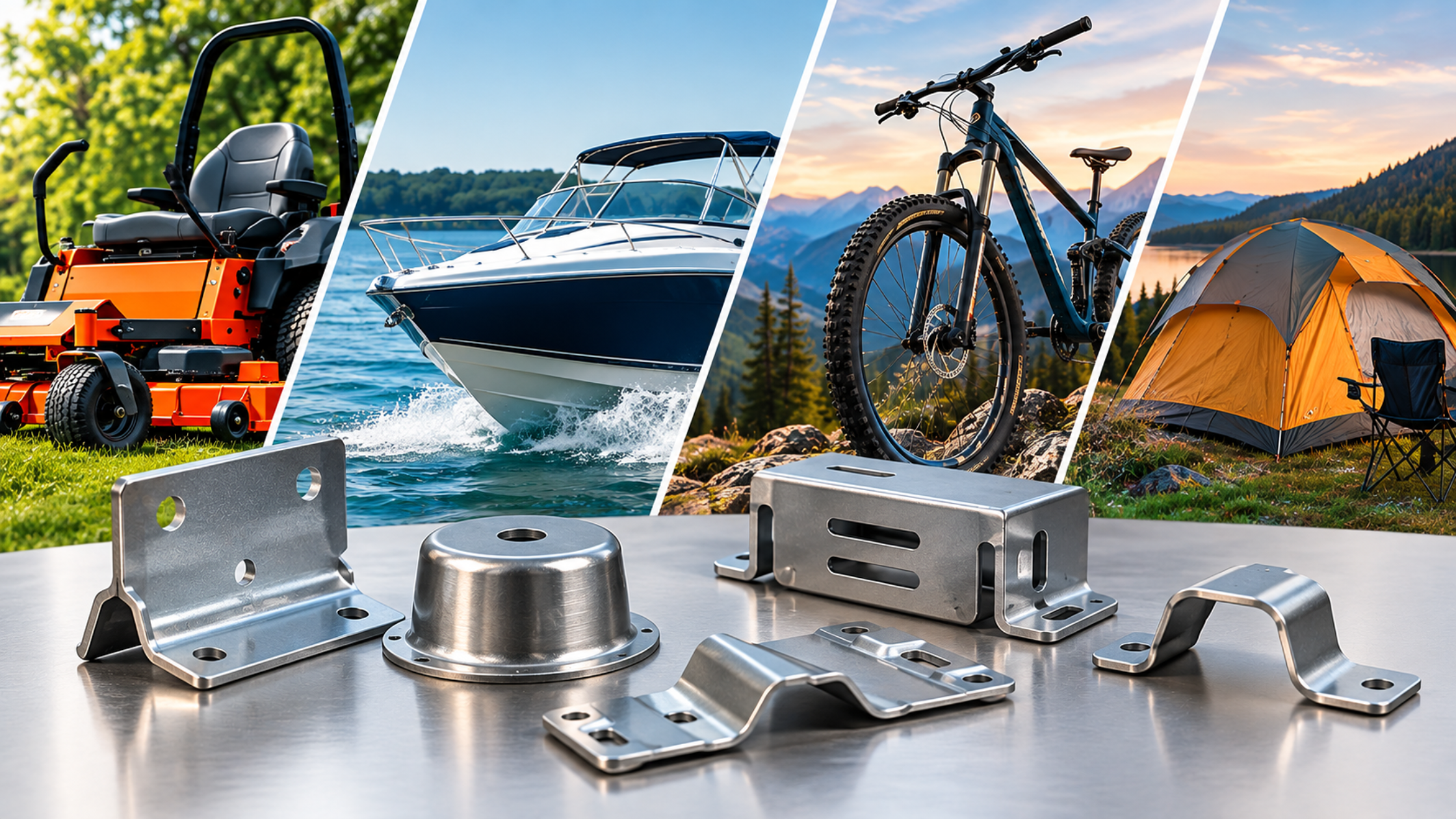
Recreational equipment covers a wide range of products, from outdoor power equipment and towable products to fitness equipment, marine hardware, and camping gear. Across all of these applications, stamping used in the recreation industry are required to hold up to real-world use while meeting the cost and volume targets of a consumer product program. Getting the part right starts with understanding how it will perform once it leaves the factory.
Performance Requirements for Recreational Equipment
Recreational products are used, moved, and handled far more often than typical industrial equipment, so the stamped components inside them need to be engineered around that use pattern.
- Components may experience vibration, repeated loading, impact, and frequent use.
- Outdoor applications may also face moisture, temperature changes, dirt, and other environmental exposure.
- Identify the functional requirements of the stamped part early: structural support, mounting, retention, protection, or another function.
Material Selection Based on the Operating Environment
Material selection should follow directly from the environment the part will operate in and the loads it will carry.
- Select material based on required strength, weight, formability, and corrosion resistance.
- Cold-rolled or HSLA steel for general structural and mounting applications.
- Stainless steel where corrosion resistance is a priority.
- Aluminum where reducing component weight is important.
- Coating or plating of steels available as necessary where additional environmental protection is needed.
Material grade and thickness must also be compatible with the amount of bending or drawing required to reach the finished part geometry.
Designing Parts for Repeated Loads and Vibration
Recreational components are frequently subject to cyclical loading, so the design needs to account for how stress concentrates around formed features.
- Evaluate areas around mounting holes, bends, tabs, and other load-bearing features.
- Consider how the component will be loaded and attached within the final assembly.
- Bend radii, material thickness, geometry, and formed features all influence durability.
- Avoid geometry that creates unnecessary forming stress or increases the potential for cracking during production.
Corrosion Protection and Finishing
Outdoor and high-exposure recreational applications place added demands on a part’s finish, and those demands should be planned for early rather than addressed after the fact.
- Determine whether the base material provides sufficient corrosion resistance or whether plating or coating is required.
- Finish requirements should account for the actual environment in which the recreational product will operate.
- Finishing requirements should be considered during part and tooling development, including how plating or coating thickness may affect final part dimensions, tolerances, and assembly. Where necessary, drawings may need to account for both pre-coating and post-coating dimensions.
Tolerances That Affect Assembly and Performance
Tight tolerances should be reserved for the features that genuinely affect how the part fits and performs within the finished product.
Focus tighter dimensional control on features that matter to the finished assembly, including:
- Mounting-hole locations and their position relative to other part features, including trim edges
- Mating features
- Diameters
- Bend locations (radii) and angles
- Formed heights
- Flanges and attachment points
Avoid applying unnecessarily tight tolerances across the entire part. PRESCO’s approach is to review which dimensions actually affect fit and function and engineer the process accordingly.
Designing for Repeatable Production
Manufacturers supplying recreational equipment programs need consistent stamped parts across repeated production runs.
- Part geometry should support a stable forming sequence and repeatable material flow, whether the part runs through progressive die stamping or transfer press stamping.
- Tooling needs to maintain critical dimensions throughout long production runs.
- Preventive tooling maintenance and in-process measurement help control variation as production continues.
Planning for Production Volume and Program Life
Stamping economics depend heavily on how many parts a program will run over its lifetime.
- Consider expected annual demand and total program life when evaluating stamping economics.
- Higher recurring volumes can justify dedicated tooling and reduce piece-part costs over the life of the program.
- PRESCO works with manufacturers looking for medium- to high-volume programs, with approximately 10,000+ pieces annually as a typical starting point depending on the application and economics.
What to Bring to a Stamping Supplier
For an effective engineering review, manufacturers should provide the following information:
- Part print/CAD
- Material specification
- Annual and lifetime volumes
- Critical dimensions/tolerances
- Functional requirements
- Expected operating environment
- Surface/finish requirements
The stamping supplier can then evaluate manufacturability, material behavior, tooling requirements, and production economics before the manufacturer commits to tooling. Teams looking for more background on related design decisions can browse the PRESCO resource library for additional guidance.
Ready to Engineer Your Next Recreational Component?
PRESCO works with manufacturers serving the recreation industry and recreational OEMs to evaluate part designs, recommend materials suited to the operating environment, and build tooling for reliable, high-volume production. Share your print or CAD file with our engineering team to get started, or explore the PRESCO resource library for more guidance on material selection, tolerancing, and production planning.