
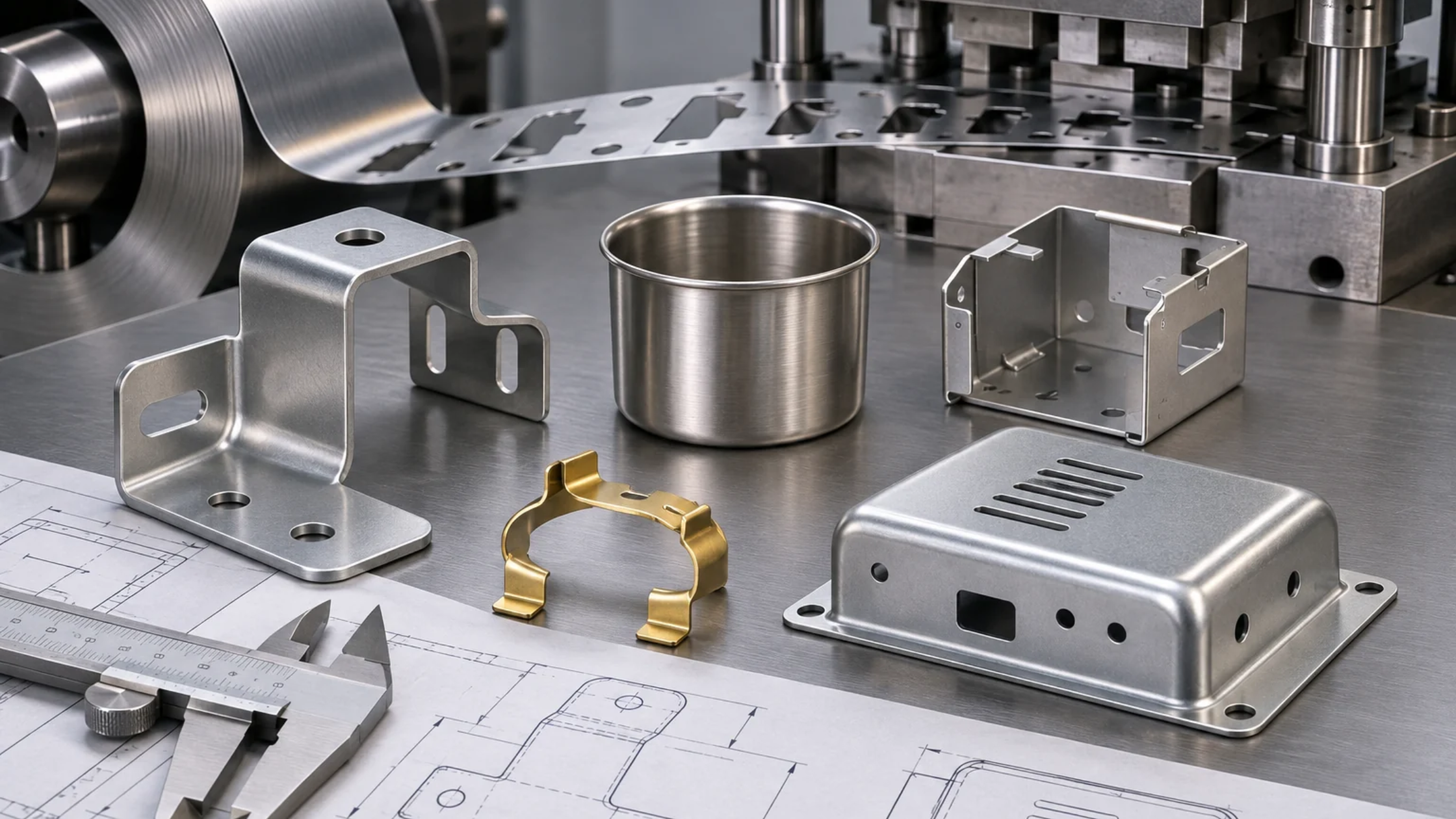
Engineers and program managers evaluating a new component often ask the same question early in development: is this part suited to metal stamping? Precision stamping parts are produced through a series of forming operations rather than through material removal, and this distinction shapes which designs succeed in production and which designs struggle.
A part does not need to be simple to qualify as a strong stamping candidate. It needs geometry, material, volume, and tolerance requirements that align with how the stamping process actually works. The sections below outline the engineering factors that determine whether a design is a good fit for precision stamping parts production.
1. Material Selection Supports Forming
Parts well suited for precision stamping can typically be formed from sheet or coil materials such as draw-quality low-carbon steel, 300- or 400-series stainless steel, 3000- or 5000-series aluminum, brass, and bronze. These materials respond predictably to bending, drawing, and other forming operations, which allows tooling to produce consistent results across a production run.
Good candidate when:
- Geometry can be created through bending, drawing, trim/piercing, beading or other forming operations.
- The design does not depend on removing material to reach its final shape.
- Common examples include brackets, retainers, housings, cups, sleeves, shells, and enclosures.
Potential poor fit when:
- The part is thick or block-like in cross section.
- Geometry requires extensive machining, deep pockets, chamfers, or similar material-removal features.
Engineers evaluate several properties during this stage:
- Material grade
- Thickness
- Elongation
- Yield strength
- Work hardening (strain) ratio
- Required draw depth and forming severity
2. The Part Maintains Relatively Consistent Wall Thickness
Stamping works by displacing and forming sheet material rather than removing it, so wall thickness across the finished part tends to reflect the starting material thickness.
Good candidate when:
- The finished geometry can maintain relatively consistent wall thickness from the original sheet material.
- For drawn parts, material can flow into the desired shape while maintaining acceptable thickness throughout the part.
Potential poor fit when:
- The design intentionally requires substantially different wall thicknesses in different areas of the same part.
This distinction is one of the clearest ways PRESCO’s engineering team separates likely stamped-part opportunities from parts better suited to machining.
3. Part Geometry Supports the Required Forming Operations
The overall geometry of the part needs to be achievable through stamping operations such as bending, drawing, piercing, and forming.
Well suited when:
- The part maintains relatively consistent wall thickness throughout the formed geometry.
- Bends and transitions can be formed without excessively sharp changes in geometry.
- Drawn features and multiple diameters can be created through a controlled sequence of forming operations.
- Features such as holes, slots, flanges, bends, and drawn sections can be incorporated into the stamping process.
4. Required Features Fit a Repeatable Forming Sequence
Precision stamping parts are built through a defined sequence of operations, most commonly progressive die stamping or transfer press stamping, and each feature on the part needs to be achievable within that sequence.
Good candidate when features such as these can be produced through a controlled forming sequence:
- Holes and slots
- Bends
- Tabs
- Flanges
- Drawn walls
- Embosses
- Diameters
- Formed heights
The part’s geometry and required forming sequence determine the appropriate tooling architecture. Tooling design follows the part, rather than the part being adjusted to fit a predetermined tooling type.
5. Production Volume Supports Dedicated Tooling
Stamping tooling can represent a significant upfront investment. That investment needs sufficient part volume to leverage the tooling to result in beneficial economics over the life of the program. Stamping can deliver a lot of value for industries that run components over long, high-volume production cycles.
Metal stamping is suited when:
- The program requires approximately 5,000 or more parts per year for 5 years or longer.
- Annual and lifetime volumes are high enough to spread the tooling investment across a large number of parts.
- The part will be produced repeatedly over several years, allowing the manufacturer to benefit from the speed and repeatability of dedicated tooling.
6. Tolerances Are Compatible With the Stamping Process
Tolerance requirements need to match what stamping tooling and process control can consistently deliver across a production run.
Good candidate when:
- Critical dimensions can be controlled consistently through tooling design and process control.
- Tight tolerances are concentrated on the features that affect fit, function, or performance.
- The design allows normal material and forming variation to be managed during production.
PRESCO can hold certain tolerances as closely as ±0.001″, depending on the feature, geometry, material, and process involved.
Final Qualification: Is This Part a Good Stamping Candidate?
Engineers reviewing a new design can use this checklist as a quick reference. A strong candidate for precision stamping parts generally has:
- A formable material such as draw-quality low-carbon steel, 300- or 400-series stainless steel, 3000- or 5000-series aluminum, brass, or bronze
- Relatively consistent wall thickness
- Formable material properties
- Features achievable through bending, drawing, piercing, or forming
- Sufficient annual and lifetime volume to justify tooling
- Tolerances achievable through a stable production process
- Geometry that can be broken into a repeatable sequence of forming operations
Parts that meet these criteria are well positioned for successful, repeatable stamping production. Engineering teams evaluating a new component can review PRESCO’s resource library for additional guidance, or talk with an engineer to have a specific part reviewed against these criteria directly.